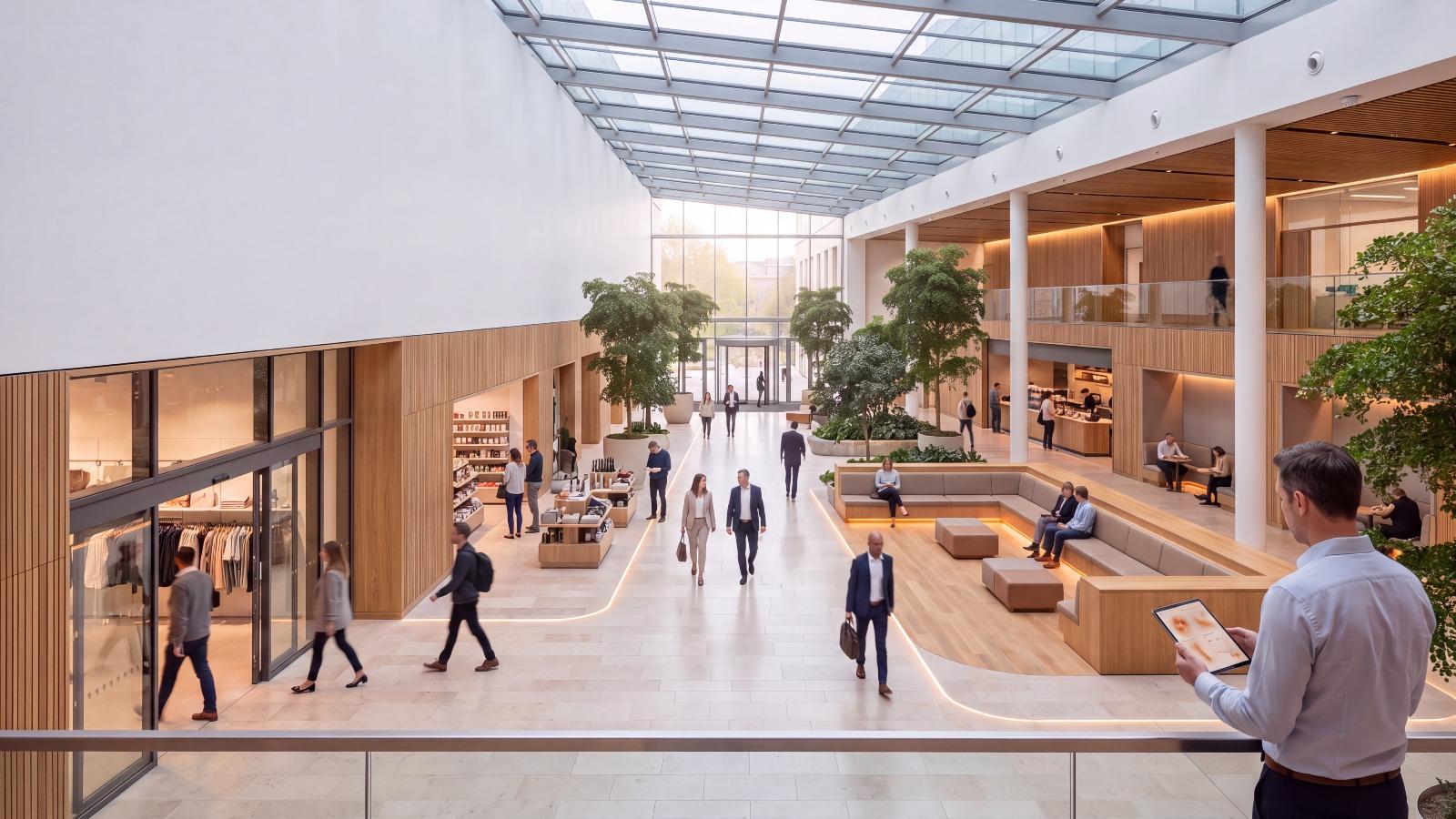
The rise of intelligent physical environments

Spaces that see, think, and act

 The rise of intelligent physical environments
  • Insight
  • 9 minute read
  • August 20, 2026

What if one of your biggest untapped intelligence assets isn't in your data lake, but all around you? 

For years, you've been able to record what happens in your physical environments. Now, advances in spatial intelligence and AI mean that environments from retail stores to stadiums, hospitals, and factories, can observe, interpret, and respond to what happens inside them in real time. 

We refer to this convergence as spaces that see, think, and act: physical environments that capture rich behavioural and operational data, reason over it alongside your enterprise data, and either inform a human decision-maker or act autonomously. 

Organisations that harness it can anticipate bottlenecks before they occur, optimise how people and assets move, improve safety, reduce waste, and make faster, more informed decisions in the moment. 

The technology is already here. The bigger question is who will recognise the opportunity first. Because the advantage compounds as intelligence builds across the environment. 

In this article, we'll explore what's making this possible, how to put the right foundations in place, what the opportunities could look like for your industry, and what leaders can do now. 

Video

Space that see video

0:30
More tools
  • Closed captions
  • Transcript
  • Full screen
  • Share
  • Closed captions

Playback of this video is not currently available

Transcript

01 The shift – from physical spaces to intelligent spaces

For decades, digital channels have had a significant advantage over physical environments. Every click, search and transaction could be captured, analysed, and optimised in real time. Physical spaces generated signals too, but they lacked the same ability to capture that data continuously and turn it into actionable insights in the moment. That gap has now closed.  

Physical environments remain where many people shop, work, learn, and receive care. In fact, despite years of digital disruption, online sales account for only around 11% of sales in retail in Australia, reflecting the enduring importance of physical spaces.1 They're rich with experiences and interactions that simply can't be replicated digitally. What's changing is what these spaces are for. They are no longer just places where activity happens. They can be active participants in the experience itself. 

This marks a fundamental shift.

Until now, most organisations have been recording what happened. CCTV footage is reviewed after an incident. Foot traffic sits in dashboards. Stock losses appear in monthly reports. Valuable intelligence often arrives too late to influence the outcome. 

Now, spaces can understand what's happening as it unfolds. 

"For the first time, technology can reveal more about customers in physical spaces than online.”

Brian Man, Partner, Retail & Consumer Industry Leader, PwC Australia

By bringing multiple data sources together, organisations can move beyond observation and towards action. Intelligent spaces can help employees make better decisions, improve customer experiences, optimise operations, or act directly themselves.  

The opportunity isn't simply to create smarter spaces. It's to transform physical environments into intelligence assets that help you learn faster, respond sooner, and create value in the moment. 

02 The technology – how spaces become intelligent

There are two enabling technologies that power spaces to see, think, and act: computer vision and agentic AI.

Computer vision gives physical environments the ability to see and sense what is happening within them. It uses spatial intelligence captures—such as cameras, RFID, shelf/weight sensors, thermal imaging, and LiDAR—with machine learning models to identify people, products, and events in an environment. It instantly translates that visual activity into structured data. Crucially, modern systems bypass the privacy pitfalls of personally identifiable data, instead, they track anonymous identifiers for the duration of an interaction and discard them immediately after.

Agentic AI gives physical environments the ability to think and act. When connected to the live data feed from a computer-vision-enabled space and to enterprise data sources (CRM, loyalty programs, ERP, sales data, inventory, workflow management tools), it can understand context, recommend actions, and—within defined guardrails and ethics—execute them autonomously.

Individually, these technologies are powerful. Together, they create intelligent environments that can behave in ways that weren't previously possible.

Stage  What the space can do The role of people 
See  Capture visual and spatial data— understand what’s happening in real time

Interpret and respond 


Think Connect information and recommend what to do next  Make faster, more informed decisions
Act  Execute within guardrails and ethics, and continuously learn Set the rules, govern, and oversee 

Customers: from passively surveilled to actively assisted

A customer enters a store looking for an afternoon snack. As they browse the food aisle, the environment interprets behaviour in real time and, where consent exists, combines it with past shopping interactions across physical and digital channels. As they pass a sandwich they have bought before, a timely discount appears in their app or on a digital shelf label. In that moment, the offer changes the customer’s decision and helps the business sell an end-of-shelf-life item that might otherwise have gone to waste. 

Employees: from data wranglers to decision-makers

Employees no longer need to piece together information from multiple systems. Instead, they begin their day with a prioritised list of actions based on live conditions across customers, inventory, operations, and external factors.

Imagine a regional sales manager arriving at work to find that an agent has already identified where stock shortages will occur, detected unusual spikes in demand, factored in a forecasted heatwave, and assessed competitor availability nearby. Rather than simply surfacing the issue, the agent has already proposed a response—rerouting inventory from another location and awaiting approval before executing the next steps. Or, if guardrails and ethics permit, the agent can act autonomously. 
 
The employee's role shifts from gathering information and driving every action, to exercising judgment, making better decisions faster, and providing oversight where required.

Businesses: from reacting to anticipating

Now step back from the regional sales manager above to consider their broader organisation. By mid-morning, another agent has already launched targeted campaigns across the right stores and customer segments, pushed dynamic pricing to electronic shelf labels, and sent personalised offers to customers.

At the same time, it's monitoring performance across a digital twin of the network, identifying where demand is rising faster than inventory levels, repositioning team members, and flagging risks before they become problems. By the end of the day, tomorrow has already been simulated.  

The business moves from reading reports about yesterday to optimising what happens next.

“Computer vision can tell you what's happening. Agentic AI can help determine what to do next. The physical environment has become less of a cost centre, and more of a data-rich, intelligent asset instead.”

Chris Smart, Manager, Retail and Consumer Markets, PwC Australia.

03 Get the foundations right

Building intelligent spaces requires both technology and leadership.

Investing in the right foundations from the start, across privacy and trust, governance, workforce, and sustainability, will bring greater reward. As our recent research has shown, when AI sits on strong foundations, it creates twice as much value.  

Trust will determine how quickly you can move. 

There are public concerns around AI and computer vision in physical environments, so you'll need to earn trust from day one. Privacy should be designed in, not added later. 

That means de-identifying data wherever possible, processing it locally so raw video doesn't leave the premises, and putting clear consent and signage in place. Advances in on-device AI, federated learning and encryption are also making it increasingly possible to harness data without compromising individual privacy. 

Australia's regulatory landscape is evolving quickly, particularly around privacy2 and biometric data.3 

Engaging legal, risk, and compliance teams early will help you embed transparency, accountability, and responsible AI practices from the outset. Such a proactive approach can accelerate innovation delivery, build customer trust, and differentiate you in the market.

As intelligent spaces become more capable, your people will spend less time on repetitive tasks and more time exercising judgement, challenging outputs, and overseeing how systems operate. 

Skills such as critical thinking, ethical oversight, and AI literacy will become increasingly important, making reskilling investment a priority. 

Just as important is bringing your workforce on the journey. If your people understand how they'll work alongside AI, you'll build confidence, accelerate adoption, and create a workforce that evolves with the technology.

Sustainability needs to be designed-in from the start. Cameras, edge devices, and AI workloads all carry an environmental cost which makes efficiency a critical design principle. As AI systems learn from enterprise data, outputs can become more targeted, helping to reduce token consumption and limit avoidable compute. Deployed well, these systems can also improve sustainability outcomes through better demand forecasting to minimise overstocking, smarter control of lighting and HVAC to lower unnecessary consumption, and predictive maintenance to improve asset efficiency and longevity. 

Building intelligent spaces isn't a single technology investment. It's an operating model shift. 

Your investment will likely span four areas: 

  • Infrastructure: AI-capable cameras, IoT sensors and edge compute (localised processing). You may be able to upgrade rather than replace and shift from an upfront hardware cost to a more accessible software cost.  

  • Data platforms: To connect physical signals with enterprise data. Cloud or hybrid data infrastructure will ingest video and sensor data, train models, and integrate with the organisation’s ERP, CRM, or other operational data.  

  • AI agent orchestration: The layer that turns information into actions.  

  • People and change: New roles, skills, training, governance models, and workforce adoption.

04 Industry examples – how might your physical environments look?

The examples below illustrate what becomes possible when physical environments move beyond simply recording activity and begin to think and act too. 

While the specific data inputs will differ by industry—blending real-time environmental data like foot traffic or shelf inventory, with enterprise data like customer preferences, workforce schedules, and transport timetables—the model stays the same: connect them and turn insight into action.

Shopping becomes a seamless omnichannel journey. AI-driven, consent-based systems create seamless

Hospitals move from reactive to proactive care. Intelligent systems help detect patient deterioration earlier, improve

Environments become self-coordinating. Vision5 and sensor data combine with timetables, ride-share, traffic, and operational feeds

Venues use computer vision to maintain dynamic crowd safety, identifying risks such as falls, fights or dangerous congestion in

Self-composing production lines reconfigure overnight and become more adaptive, with AI helping optimise workflows, reposition inventory, improve

< Back

< Back
[+] Read More

05 Five essential questions for leaders right now

“The advantage of intelligent spaces compounds over time. The earlier you start, the more operational intelligence you build—something competitors can't easily recreate.”

Tom van Dongen, Senior Associate, Retail and Consumer Markets, PwC Australia

Technology can be purchased. Years of intelligence cannot. So, will you harness this intelligence for your organisation, or watch someone else do it first? Five questions can help you get started. 

Every day, your people, assets, and operations generate thousands of signals. Which ones are you already capturing? Which ones are you overlooking? And how much of that information is currently trapped in disconnected systems? 

Many organisations still rely on reports that explain what happened yesterday. Which operational decisions could be made faster, or even proactively, if physical and enterprise data worked together? 

Not every environment needs the same level of intelligence. Where would reducing friction, anticipating demand, or improving resource allocation create the biggest impact for your customers, employees, or operations? 

Privacy, governance, and workforce adoption can't be an afterthought. How will you ensure your intelligent spaces are transparent, trusted, and aligned with your organisational values?  

You don't need to transform every physical environment overnight. But waiting for the technology to become more mature may mean missing valuable years of learning, experimentation, and operational readiness. A head start will create a true competitive difference.  

  1. Australian Bureau of Statistics, Retail trade: A journey through 75 years of retail statistics. Available at: https://www.abs.gov.au/articles/retail-trade-journey-through-75-years-retail-statistics

  2. Parliament of Australia, Privacy and Other Legislation Amendment Bill 2024. Available at: https://www.aph.gov.au/Parliamentary_Business/Bills_Legislation/Bills_Search_Results/Result?bId=r7249

  3. Office of the Australian Information Commissioner, Facial recognition technology: A guide to assessing the privacy risks. Available at: https://www.oaic.gov.au/privacy/privacy-guidance-for-organisations-and-government-agencies/organisations/facial-recognition-technology-a-guide-to-assessing-the-privacy-risks

  4. PwC UK, Frictionless futures: The future of shopping. Available at: https://www.pwc.co.uk/issues/assets/documents/frictionless-futures-future-of-shopping.pdf 

  5. CDO Magazine, Dubai Airport unveils world's first AI-powered passenger corridor. Available at: https://www.cdomagazine.tech/aiml/dubai-airport-unveils-worlds-first-ai-powered-passenger-corridor

  6. Lenovo, FIFA case study. Available at: https://www.lenovo.com/au/en/case-studies-customer-success-stories/fifa

  7. Forbes, The future of AI in experience design at LA’s Intuit Dome. Available at: https://www.forbes.com/sites/charliefink/2025/11/09/the-future-of-ai-in-architecture-and-design-in-las-intuit-dome/

  8. NVIDIA, Industrial edge AI with NVIDIA IGX. Available at: https://blogs.nvidia.com/blog/igx-industrial-edge-ai/ 

Authors

Brian Man

Partner, Retail & Consumer Industry Leader, PwC Australia

Contact form

Tom Harden

Director, Advisory, Retail and Consumer, PwC Australia

Contact form

Chris Smart

Manager, Retail and Consumer Markets, PwC Australia

Contact form

Tom van Dongen

Senior Associate, Retail and Consumer Markets, PwC Australia

Contact form

Jackson Boyd

Associate, Retail and Consumer Markets, PwC Australia

Contact form

Follow PwC Australia