











We're entering a new era in commerce. For decades, retailers have focused on influencing how customers discover, compare, and buy. But what happens when your customers stop shopping for themselves?
AI agents are beginning to research products, evaluate options, and complete purchases on behalf of customers. This shift to agentic commerce won’t just reshape discoverability, loyalty, pricing, and payments. It will change how competitive advantage is created and captured.
As agents become a new interface between customers and brands, being the brand customers prefer may no longer be enough. You will also need to be the brand their agents can find, trust, and transact with.
This article explores why agentic commerce matters, the risks it creates for retailers, and where you should focus your efforts today.
Your next customer won’t be human Commerce has a habit of rewriting the rules.
Every era of commerce has had its own source of advantage. Now, the new customer interface is not a store or a screen—it’s an agent.
The basics What is agentic commerce?
Agentic commerce is a model of digital buying where AI agents act on behalf of customers to interpret needs, compare options, and increasingly complete transactions.
It can take several forms—from AI assistants helping customers shop, to more advanced models where multiple agents work together to complete a purchase. While this level of automation is still emerging, it's important to understand where things are heading.
Imagine a customer telling their AI assistant: "Help me find a lightweight but sturdy carry-on suitcase that will fit enough clothing and shoes for a long weekend. I also want to easily access my laptop."
The agent translates those preferences into specific product requirements. It compares options across retailers, evaluates reviews, checks stock availability, applies discounts or loyalty benefits, and presents a shortlist.
The conversation doesn't have to stop there. The customer might ask: "Which one is the lightest?" or "Do any come in navy?" or "Can you show me options under $250?" The agent refines its recommendations in real time, narrowing the choices based on the customer's preferences.
Once the customer selects a preferred option, the agent completes the purchase. No search engine.

No comparison sites. No retailer websites. What was once a multi-step shopping journey becomes a single conversational request.
Gartner predicts that 60% of brands will use a form of agentic AI by 2028.1
The funnel How AI agents are changing the retail funnel
For the past 30 years, digital commerce has assumed a human in the loop. Customers searched. They browsed. They clicked. They compared. They abandoned carts. They returned. Every stage generated signals and created opportunities for retailers to influence behaviour.

When an AI agent handles the buying journey, much of the traditional funnel disappears from view.
The first signal you receive may be the transaction itself. The stages that once sat before it become increasingly invisible.
That changes discoverability. Retailers have spent decades optimising for shelf position, search rankings, and advertising. AI agents evaluate a different set of signals. They don't respond to display banners or end-of-aisle promotions. They rely on structured, machine-readable information to make decisions.
The implications run deeper still. Many systems that underpin modern commerce were designed around human behaviour. Attribution models assume customer journeys can be tracked. Loyalty programs assume direct customer engagement. Fraud controls, payment processes, and tax frameworks all assume a person is making the purchasing decision.
As agents become participants in commerce, those assumptions start to break.
The risks The biggest risks of agentic commerce for retailers
Risk 01
|
Risk 02
|
Risk 03
|
|---|---|---|
| AI agents evaluate algorithmically. They assess structured information, trust signals, availability, and relevance to determine the best option for a given task. Many of the assets you have traditionally relied on to influence choice—brand, packaging, shelf position—become much less influential, if at all. |
Agents are relentless optimisers. They don't care about emotional attachment to a brand. They prioritise outcomes. If two products are broadly comparable, the agent is likely to favour the one that is cheaper, available, and able to fulfil the requirement. | When an agent owns the customer interface, it also owns much of the customer relationship. Today, loyalty is built through direct interactions between customers and brands. As more of those interactions move through AI agents, you have fewer opportunities to build and reinforce that connection. The risk isn't just losing. |
| WHAT IT MEANS You are either the recommendation, or you are not. |
WHAT IT MEANS The $98 option beats the $100 option every time. |
WHAT IT MEANS The risk isn't just losing loyalty. It's losing direct access to the customer altogether. |
What to do now How retailers can prepare for agentic commerce
The good news is that investments in digital commerce, customer data, loyalty, content, and technology remain valuable. In many cases, they are the foundation for what comes next.
The challenge is extending those capabilities for an agent-driven world.
You need to be:
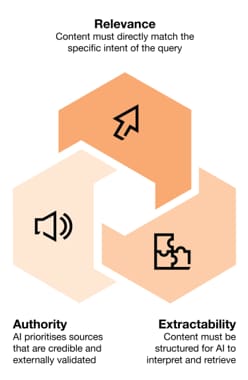
Discoverable – your products, services, and offers are relevant to customer intent, supported by trusted signals and extractable—presented in a machine-readable format. Each of these work together. Strong performance in just one or two will not be enough to be consistently surfaced by AI agents.
These capabilities won't emerge overnight. But they are quickly becoming the building blocks of competitive advantage.
More fundamentally, they determine whether you can participate in the transaction at all. In an agent-led world, being invisible to an agent increasingly means being invisible to the customer.
Where Australia sits Australia's agentic commerce opportunity
Australian retailers are still in the early stages of agentic adoption. But agentic commerce isn't one thing. Three dominant interaction models are beginning to emerge, each with a different level of maturity and implications for retailers.
- Branded agent (agent-to-consumer)
- Personal shopping agent (business-to-agent)
- Multi-agent autonomy (agent-to-agent)
Branded agent (agent-to-consumer)
Sees brands deploying AI agents to their own platforms to help customers discover, compare, and purchase products. Australian retailers are already moving in this direction. Bunnings' ‘Buddy’ helps customers plan projects, find products and build carts2. Kmart's ‘Joy’ enables conversational shopping and virtual product visualisation, while Woolworths has expanded ‘Olive’ into an AI shopping assistant that can build meal plans, create baskets and identify product alternatives.3 4
Similar models are also emerging iIn the US, through assistants retailers such as Amazon's Rufus and Walmart's Sparky.5 6

Personal shopping agent (business-to-agent)
Sees retailers preparing their businesses for a world where third-party AI agents (e.g. ChatGPT, Claude, Gemini) search, discover, make recommendations and potentially transact on behalf of customers.
Multi-agent autonomy (agent-to-agent)
While potentially a longer-term play is where multiple agents coordinate activities across discovery, loyalty, payments, and fulfilment with minimal human intervention.
In China, major e-commerce platforms are integrating AI agents into ecosystems that already combine discovery, payments, and fulfilment, providing an early glimpse of where this more connected future could lead.
The reality is that retailers will soon need to serve two audiences simultaneously: humans and agents. One will continue to browse, compare, and buy. The other will increasingly do those things on their behalf.
The immediate priority isn't building for a fully agentified future. It's ensuring your business can participate in the agent-led journeys already beginning to emerge.


