









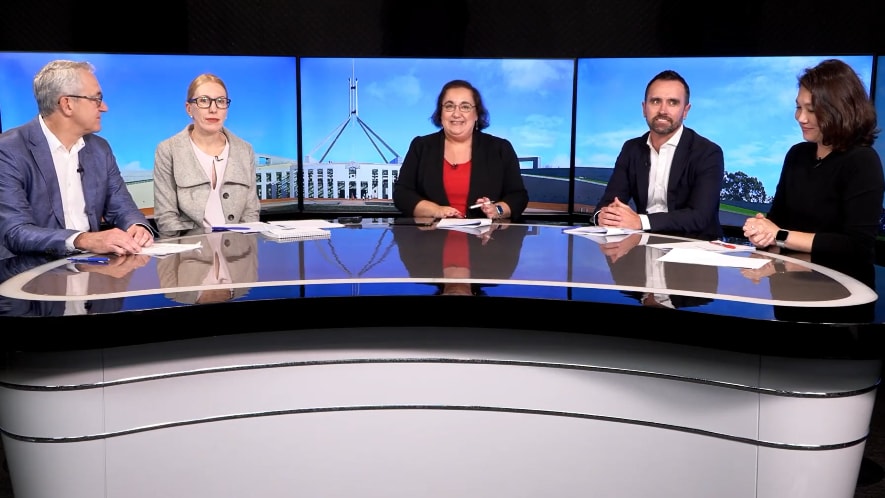
PwC’s May 2026 Tax Briefing examined the Australian Government’s 2026–27 Federal Budget, containing one of the most significant tax reform packages in recent years. While there was considerable speculation ahead of the Budget night, the measures announced went beyond expectations in both breadth and complexity, heralding a material shift in the operating environment for individuals, investors, and businesses.
Following an economic update by PwC Chief Economist Amy Lomas, a panel of tax experts featuring Warren Dick, Ryan Smith, and Trinh Hua discussed the tax measures announced in the 2026–27 Federal Budget.
Major tax reform measures: CGT, negative gearing, and trusts
The Budget introduces a series of structural reforms affecting individuals, families, funds, and businesses.
For capital gains tax (CGT), changes are proposed from 1 July 2027, including the replacement of the 50% CGT discount with a cost‑based indexation approach, the introduction of a minimum 30% tax rate on net capital gains, and the extension of the regime to include gains on pre‑CGT assets from that date. Transitional rules are expected to be a key source of complexity, particularly in determining valuation and timing outcomes.
In relation to negative gearing, losses on established residential rental properties are proposed to be quarantined from 1 July 2027. These losses would only be available to offset residential rental income or be carried forward to reduce capital gains on disposal. Residential properties held prior to Budget night are grandfathered, while losses from investment in newly constructed residential properties are not impacted and continue to be fully allowable after 1 July 2027.
A further measure introduces from 1 July 2028 a minimum 30% tax rate for discretionary trusts, applied at the trustee level with credits available to most beneficiaries, but not corporate beneficiaries. The measure includes carve‑outs for fixed trusts, widely held trusts, complying superannuation funds, and certain excluded income types.
Business measures and productivity: Supporting resilience and innovation
From a business perspective, the Budget includes several measures aimed at supporting productivity and resilience.
Changes to the research and development tax incentive regime were highlighted, alongside the reintroduction of loss carry‑back as a permanent feature. This measure allows eligible companies with aggregated global turnover of less than $1 billion to carry back losses for up to two years, applying from 1 July 2026.
A further start-up measure enables eligible small businesses to convert losses in their first two years into a refundable offset linked to certain employee‑related taxes. This initiative is proposed to apply from 1 July 2028 and is intended to support cash flow during early-growth phases.
Outlook: Scale of change and implementation pathway
The discussion highlighted the scale and pace of change, noting that a significant number of technical aspects remain unresolved. Many of the measures are expected to be subject to consultation, draft legislation, and further refinement over time.
Overall, the 2026–27 Federal Budget represents a substantial shift in Australia’s tax settings, with wide-ranging implications across investment structures, funding decisions, and compliance obligations. At the same time, the volume of detail yet to be settled underscores the importance of closely monitoring developments, engaging early with emerging positions, and preparing for a period of ongoing change as the reforms move from announcement through to implementation.
Watch this Tax Briefing on demand here. You can also read PwC’s detailed analysis of the tax measures in the 2026-27 Federal Budget here.


