









ATO Findings report – Top 100 GST assurance programs

6 December 2022
In brief
The ATO has issued its findings report from Top 100 income tax and GST assurance programs completed to 30 June 2022. These findings provide important insights which can be used by taxpayers as a roadmap towards an improved GST assurance rating. Certainly, from a GST perspective, the findings show that the majority of taxpayers are now achieving a medium to high level of assurance.
From a GST perspective, 71% of the taxpayers that comprise the top 100 population have been subject to GST assurance reviews in the last two years, with 47.5% being completed up to the end of June 2022. For the GST assurance reviews completed to date, 68% of taxpayers received an overall medium level of assurance and 32% have received an overall high level of assurance.
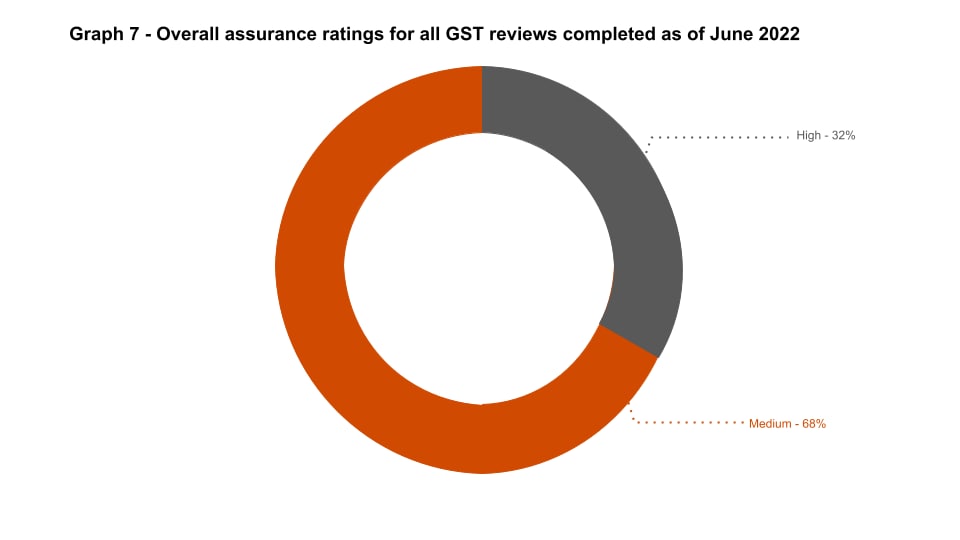
Source: Findings report – Top 100 income tax and GST assurance programs, ATO 13 October 2022
In the majority of cases, the key reasons for taxpayers not achieving an overall high assurance rating was due to a stage 1 rating for GST governance (this rating reflects that you provided evidence to demonstrate a tax control framework exists). A stage 2 rating (which reflects that you provided evidence to demonstrate that a tax control framework exists and has been designed effectively) is a minimum requirement for achieving high assurance overall.

Source: Findings report – Top 100 income tax and GST assurance programs, ATO 13 October 2022
In detail
Importantly, the ATO’s findings arm taxpayers with key insights and information about how to achieve a higher level of assurance. Central to this is being able to provide objective evidence that an effective GST control framework exists and that key GST risk areas are appropriately managed.
What can you do to achieve improved assurance outcomes?
Given that an overall high level of assurance can only be obtained if a stage 2 rating is achieved for GST governance, the following are important to have from a best-practice perspective:
- Board level commitment to implementing a well-designed periodic GST control testing plan that covers all the Board Level and Managerial Level controls as outlined in the ATO’s GST guide. Best practice and a stage 3 rating would require evidence that taxpayers have independently tested the operation of the control framework per their periodic GST control testing plan.
- Documented evidence of a process for reporting material matters or risks to the Board which is tailored to GST.
- Documented procedures for identifying and determining whether GST sign off is required for significant transactions and escalation procedures.
- Documented procedures which evidence the controls in place for data including for manual adjustments.
- Evidence of manual controls and automated GST controls built into business systems for the set-up, review, and maintenance of tax codes.
- Documented work instructions in place for GST compliance procedures for the preparation, review, and approval of the BAS.
- Supporting data analytics for GST compliance procedures such as exceptions reporting and trend analysis.
What particular areas of risk should you review?
The ATO has advised that the risk of top 100 taxpayers incorrectly reporting their GST obligations continues to be a key focus area. A key driver for errors in GST reporting are governance and systems-related issues. Other drivers include implementation of/migration to new business systems, personnel issues (such as staff turnover or leave) leading to resourcing and capability gaps, incorrect interpretation of the law through lack of knowledge or capability, or new/one-off transactions where internal controls are not in place to handle events outside of the core business activities.
Other critical GST risks that the ATO has flagged where a GST health check would be recommended include:
Financial supplies
- Is monthly testing of the Financial Acquisitions Threshold (FAT) undertaken and evidenced?
- Are reduced input tax credits being claimed for ineligible costs?
- Have the reverse charge provisions been correctly applied to cross border transactions?
GST food classification
- Is there a regular review of product master data and is this evidenced?
- Has the GST classification of products been properly reviewed (reliance on a supplier’s classification is insufficient)?
- Are there GST controls around onboarding new products?
Property
- Has the margin scheme been applied correctly?
- Has the GST classification of residential accommodation and/or commercial residential premises been reviewed?
- Have the requirements for supplies of going concerns been satisfied?
- Have agency issues in relation to who is making the supply been correctly reflected for GST purposes?
- Have adjustment events been properly considered and reported?
Recipient created tax invoices (RCTIs)
- Are valid RCTI agreements in place?
- Have RCTIs been issued to the correct supplier?
- Are RCTIs being issued to suppliers who are not GST registered or no longer GST registered?
How else can you prepare?
Data and transaction testing
The ATO uses data and transaction testing to assess correct reporting in the top 100 GST assurance program and expects taxpayers to undertake robust and regular assurance and verification procedures that align with their business, and that are tailored to their own operating environment.
Undertaking data testing before an ATO review is notified allows for early identification and investigation of potential errors. Where independent testing can be relied upon by the ATO, it can also result in a shorter and less intrusive ATO data review, saving time and effort.
GST Analytical Tool (GAT)
The ATO applies the GAT to each top 100 GST assurance review and is of the view that it is a useful tool for taxpayers to use to check how their various streams of economic activity are treated for GST purposes. Further, the ATO expects, as part of good GST governance that taxpayers have a process in place to explain BAS reporting of GST payable and receivable compared to business outcomes, as well as to explain the key variances in comparison to financial statements. Therefore, undertaking a GAT in preparation for an ATO review will provide better alignment with ATO better practice and should result in improved outcomes.
A GAT is not intended to be used for entities that make predominantly input taxed supplies.
Future GST engagement after initial GST assurance review
The ATO has advised that top 100 taxpayers who received an overall high or medium level of assurance can expect to be reviewed on a periodic basis at least every 4 years unless there are efficiencies to conduct the refresh review earlier. However, taxpayers with a medium level of assurance can expect targeted GST assurance activities in the period following the initial review to address any areas of concern, including any gaps in GST governance.
Taxpayers with an overall low level of assurance will be subject to an annual comprehensive justified trust review. Further details on how the ATO will engage with top 100 taxpayers following an initial GST review can be found here.
Conclusion
The information and insights provided by the ATO’s findings paves a much clearer path for taxpayers to follow in order to achieve an improved assurance rating. PwC can also provide tailored assistance to clients wanting to prepare for an ATO GST Assurance review which is structured and aligned with ATO expectations, including assessing what documentation exists or otherwise should be put in place and/or refined from a GST governance perspective and also looking at which of the industry specific technical issues identified by the ATO may be relevant to clients and assessing whether the historical position(s) adopted is aligned with the views put forward by the ATO.
Based on the results from the last 12 months, it appears that more taxpayers are seeing the benefits of following this path not only because it results in a good assurance outcome with the ATO but because a robust GST governance framework can result in improved processes, increased visibility over potential errors and therefore greater ability to mitigate risk or identify opportunities.
For those that don’t follow this path, there is the potential for a rockier road with an increased likelihood of further and/or more frequent ATO engagement.
For more information, please contact the PwC Indirect Taxes team.
Matthew Strauch
Partner, Tax Reporting & Innovation Leader, PwC Australia
Suzanne Kneen
Partner, Tax Reporting and Innovation, PwC Australia
Shagun Thakur
Partner, PwC Australia
Brady Dever
Tax & Legal Alliances Market Lead, PwC Australia
Mark Simpson
Partner, Tax, PwC Australia
Andrew Howe
Partner, Global Tax, PwC Australia


