









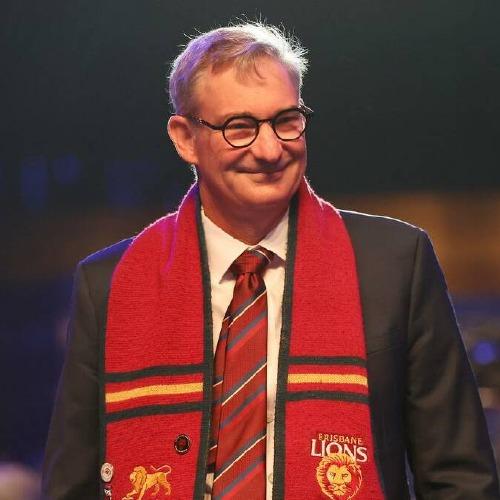
Full Name: Andrew Wellington
Current Role: Chair
Current Organisation: Brisbane Lions, Queensland Rail, Ellerslie Farms
Last Role at PwC: Partner
Time at PwC: 1989 - 2023
What’s your fondest memory from your time at PwC?
It’s impossible to narrow it down to a single memory. All my fondest memories revolve around the people I worked with. I was very fortunate to spend time in three offices, Perth, Nassau (Bahamas) and Brisbane. In every office I made some great friendships and was fortunate to be mentored by some remarkable people.
After two decades as a PwC Partner, are there foundational PwC skills or values that you still actively apply to your work?
The deep financial literacy you acquire after many years working at PwC is invaluable in all my Board roles. Having a people first mindset when you deal with your own people and then with clients is also something that I am always actively applying. In professional sport you have a broad range of stakeholders. Sponsors and fans are equivalent to your clients, and you need to be able to put yourself in their shoes to understand their experiences.That is very similar to how we were encouraged to think at PwC.
Transitioning from a global consulting firm to a major AFL club is a significant shift. What was the most surprising aspect of this pivot, and what advice do you offer alumni contemplating an industry change?
I commenced the Chair role at Brisbane Lions while I was still a partner at PwC. PwC allowed me to move to a 4-day work week to enable me to remain a partner at PwC and take on the Lions role. The aspect of the transition that I was pleasantly surprised by was how relevant the skills and experience I had from PwC were. I suppose I shouldn’t have been surprised, but I joined PwC as a graduate so the bulk of my meaningful professional experience to that point was from PwC, and it was pleasing to see how relevant that experience was in terms of managing people and stakeholders.
In terms of advice on changing industries it’s hard to provide specific advice as everyone’s circumstances will vary. But I would say that when contemplating a change, it’s important to be honest with yourself about why you want to change and what are you looking for. Then identify how the existing experience you have will add value in the new industry. Finally, be prepared to compromise on your immediate expectations if you want to change direction, you may not be able to jump straight into the type of role you want, but there will be different ways of getting there.
What universal leadership principles have proven effective in both corporate and sporting realms?
Caring for people and maintaining your integrity are critical principles in both the corporate and sporting realms. Building trust with people is important and it is difficult for people to trust you if they don’t believe you care, both about them as individuals and what you are trying to achieve collectively.
You still need to be able to have difficult conversations, hold people accountable and sometimes move people on, but if people trust you and know there is a genuine level of care, those challenges are typically easier to manage.
Likewise with integrity, it is very difficult to be trusted by your people or other stakeholders if people believe your integrity can be compromised.
Finally, being able to articulate a vision for what sort of organisation you want to be is something that is essential in both the corporate and sporting worlds.
Whether at PwC or the Lions, talent is key. What are the key similarities and differences you've observed in building a winning culture and fostering elite talent in competitive environments?
The key similarities are people related. Both at PwC and the Lions a key part of success is:
Attracting great talent
Developing that talent
Retaining the talent
An essential part of attracting and retaining talent is creating an environment people want to be part of. You also have to be prepared to invest in development and tailor it to an individual’s needs.
I then come back to caring and building trust with people, if you have that you can have conversations about an individual’s development needs without them feeling threatened and they will feel empowered to make themselves better.
Another similarity is that an organisation is at its best when people value team success over individual success. At the Lions we do celebrate individual success, but we talk a lot about the importance of team success and how that trumps individual success. When you look at the highest performing parts of PwC over the years, I think they have also had that mentality.
One key difference is the performance feedback in professional sport is very regular and direct, it’s driven by the scoreboard, albeit that can’t be your only KPI. At PwC it is not always easy to measure performance as directly.
Another difference is the complexity and size of PwC compared to a sporting organisation. At the Lions we operate just 3 teams (AFL, AFLW and VFL). At PwC there are many times that number of teams with multiple business lines and multiple offices that you are trying to create a common ‘winning’ culture across. That becomes very complex.
During your time at Brisbane Lions, the club has won two back-to-back premierships in the men’s competition and two premierships in the women’s competition. Beyond the flag, what legacy do you hope to leave at the Brisbane Lions?
People constantly come and go at football clubs, and everything is done in teams, so I don’t ever speak of me leaving a personal legacy.
However, if I answer the question in terms of things I have been proud to be part of and I hope others can continue, they include:
I would like to think we have played a role in growing Australian Rules football as a code in Queensland. Participation rates in community football in Queensland have grown significantly in recent years, as has Brisbane Lions membership and crowds.
We have also been strong proponents of women's participation in the game and value the role they play in the game. We are very proud of our AFLW program and celebrate its success.
Being a club that stays grounded and connected with its fans and other stakeholders.
As the Chair of multiple Boards, how do you typically balance governance with commercial needs across your organisations?
Good governance is commercial, so in that sense it is easy to balance.
I try and focus on the ‘why’. The reason it’s important to understand which risks are most important to monitor and manage is because that is what helps preserve value in your organisation. All organisations, and particularly football clubs, have a social licence that must be maintained, and good governance is essential in doing that. So when we discuss governance issues, we remind ourselves of the context and why we are doing it, it can’t just be a box ticking exercise.
Having said that, on each of the Boards I chair we ensure there is enough time set aside to discuss strategic issues with the executive team, challenge the executive team on strategy and identify particular areas where the Board can support the strategy.
In overall terms we try and ensure the Board sets the right tone, so everyone understands what the non-negotiables around cultural and governance issues are.
What advice can you share with anyone looking to start a Board career?
Be clear on what you are looking for from a Board career. For example, I found I enjoy the ‘team’ aspect of a Board, acknowledging that the best Boards aren’t made up of people who agree all the time. Good debate is essential, but once the debate is over everyone has to work together. But I know others are frustrated by that aspect of a Board, so it’s not for everyone.
Some are attracted to the greater remuneration and profile that come with listed Boards while others will prefer private Boards where you may get to spend more time with management on strategic and business issues.
Talk to people who are on Boards and people who do Board placements to get a good sense of what Boards are looking for and understand where your skill set and experience align.
If you could invite three people to a dinner party, dead or alive, who would they be and why?
Loved ones who are no longer with us is an obvious one, but I appreciate not interesting for everybody else! Three I would choose are:
Leonardo Da Vinci – He possessed one of the greatest minds the world has seen, as well as being a gifted artist. He was drawing and designing things like helicopters and aircraft centuries before they became a reality. So it would be fascinating to listen to him and get an insight into how his mind worked.
John Wellington – My great, great grandfather was convicted as a jewel thief in London, having stolen what in today’s dollars would be well over $2m in jewellery. In 1864 he was sentenced to 14 years jail and transportation to Geraldton, where he remained after completing his sentence. My parents and siblings were all born in Geraldton and I finished high school there. I would love to hear what he thought about being transported to the other side of the world and starting a new life there, as well as share with him how some of his descendants have fared post his misadventures in London!
Rosa Parks – It is difficult to understand today how intimidating it would have been for Rosa Parks to make the non-violent stand she did on civil rights in Alabama in the 1950’s. I am sure she could provide some great lessons on standing up for your values in a challenging environment.
Are you a member of our PwC Australia Alumni LinkedIn group? Join here and connect with PwC and your fellow alumni, get real-time updates, participate in meaningful discussions, and expand your professional network.


